Tuesday, April 8, 2025


(BAR-45) Sci-Fi F1 ZER0 Racer

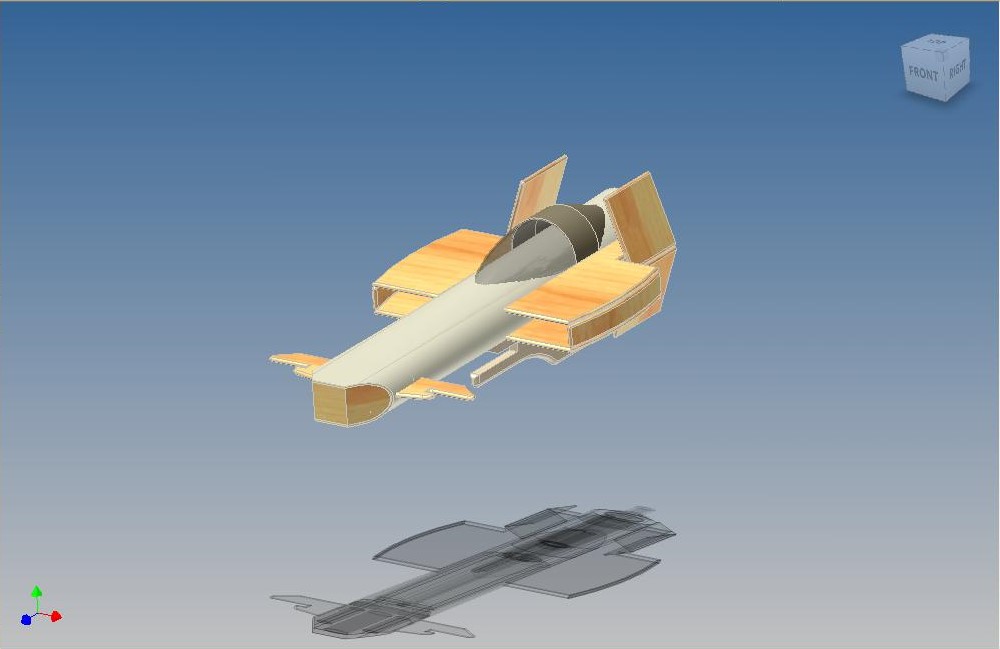
This is a design I found on the Internet: Sci-Fi F1 Zer0 Racer.

It's got an F1 vibe going, yet it's got enough rear mounted fins to make a good simulated flyer.​
​
I'll need to use my oval tube forming technique for the body, starting with BT/C-204 and forming the nose into a rectangular shape, and then make a nose cone to match up to that shape. The rest of the rocket is fairly straightforward. I will not be installing the front canards, at least not for flight.​
  • Basswood and Plywood Fins
  • Rear Mounted 29mm Motor
  • 24" Parachute


2025-04-10 Forming the Body Tube

A piece of BT-204 was cut to 13" long.​
​
Checked the stock here and there isn't any C-204 (??) so a piece of C-80 was cut to 13" long and then (2) longitudinal cuts were made in the tube, spaced 6-3/16" to make a split internal coupler. I then used Elmer's White Glue to glue the coupler inside the BT-204.​
​
After waiting an hour for the Elmer's White Glue to cure a bit the tube sub-assembly was soaked in water, about 4 inches at the end of the BT/C-204. Then my BT-60 Oval Tube Mandrels were used to form an oval on the end of the tube. It was clamped for drying.​
​
The coupler longitudinal split will be wood glued tomorrow, after the forming operation has dried.​


2025-04-11 I've settled on the design...  something like this:
 

Nose Cone CAD & Drawing

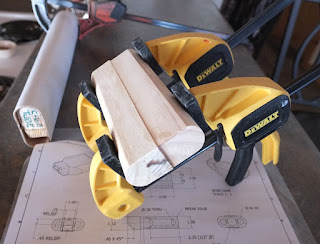
Knocked out a CAD Model and Drawing for the Nose Cone... and glued up the wooden blank.​


2025-04-12 
Fabricated the Nose Cone today. It's not quite as "pretty" as the CAD model, but it'll get the job done.


Glued the Nose Cone into the Body Tube.


 2025-04-14 Cutting The Nose Cone Angles

Used the Radial Arm Saw to cut the two side angles on the Nose Cone.​
 

2025-04-14 CAD Model and Drawing

Here's the preliminary drawings, still need to do the details.


 Starship Nova... A BT-60 Upscale

The Starship Nova was an Estes sci-fi rocket design from back in the early 1980's.  It had lot's of tubes, weird fins and a funky nose cone.​
 
For me, this 1980's era was when I had abandoned rocketry. Cars, girls and college were my main focus at that time. But now, maybe an upscale of this rocket would be a fun adventure.​​
 
Here's a stock Starship Nova OpenRocket simulation that I created, using The Estes' Instructions and fin templates for Kit No. 1371​. 
 
Armed with this OpenRocket simulation, I'll work up an upscaled version of the rocket.​ 


Starship Nova Upscale BT-60

The Stock Estes model was scaled up in OpenRocket to a BT-60. The length of the Body Tube was reduced to 17".​
​
The Nose Cone was rotated 180 degrees. It is solid pine and a ballast of 3/4" Dia. Steel Bar was added, 1" long.​
​
An oval shaped BT-60 was used for the Lower Tube, which also acts as Altimeter Stowage.​
​
BT-80 Tube Fins are used​
​
A Rear Eject configuration is used. The 29mm Motor ejects out of the back, which is attached to the Recovery Spool with a Shock Chord, which deploys the 30" Parachute.​
​
Dual Launch Lugs are used... which are actually rapid fire pew-pew cannons. 


 2025-07-14 Starship Nova MKII Heavy

Upscaled this to a BT-80, shortened the main body tube, scaled the fins down 75%, and changed the lower fins to sweep forward.​


Wednesday, March 26, 2025


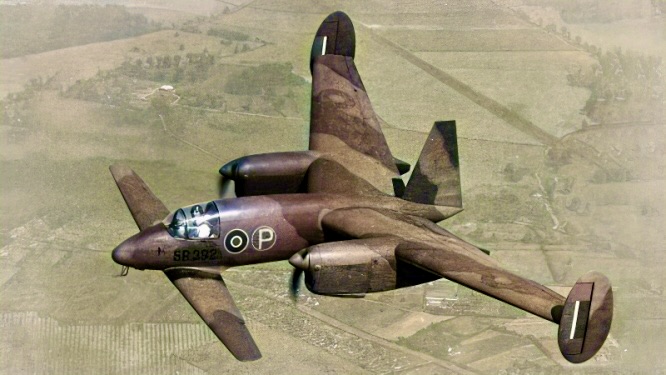
Miles M.39C Libellula... A WWII Odd-Roc

 Here's a rather obscure British WWII plane that seems to work nicely as a rocket pretty much as is.

Miles M.39B Libellula Wikipedia

The Miles M.39B Libellula (from Libellulidae, a taxonomic family of dragonflies) was a Second World War tandem wing experimental aircraft built by Miles Aircraft, designed to give the pilot the best view possible for landing on aircraft carriers. A scale version of the M.39 design was proposed by Miles to meet Air Ministry specification B.11/41 for a fast bomber. The M.39B was used by Miles to generate data from which the M.39 design was improved, but the M.39 project was cancelled and the M.39B broken up.​
​
The M.39C was a pusher version... and that's similar to the rocket I've created below.

I moved the motor nacelles in tight to the rear tailcone. The ejection will be through the side wall of the motor tube into the fuselage, and the parachute will eject via bomb bay doors on the bottom of the rocket. At least that's the plan.

I wanted to use some 29mm Estes black powder motors but the off the rod speed is less than 30 mph. Using composite 29mm motors only (1) is req'd... so I can cluster the two motors without fear of one not lighting.

Looks like a fun project. I may opt to not use the front canards.... but I had good luck with my Hammerhead.


A couple of videos...

 
2025-04-07  CAD Model