Thursday, March 30, 2023

Test Mule: Neato! Train Whistle Rocket


2026-03-30  Bought this toy train whistle at Tractor Supply, three years ago to this day. 
Weird right? Lets see if we can make this one whistle!
 
Took the Whistle out to the shop and drilled a 1" dia. hole x 1-3/4" deep Counter Bore in the end. That's where one of the (4) whistle bores stopped. (There's 4 holes at different lengths... that gives it a "Train Whistle" sound, a "Chord" if you will.)

Then started gluing a 3" long piece of BT-52HMF to the bored end.

Ran a couple of quick Open Rocket sims to get a feel for how big the fins need to be. I know, I know... it won't simulate correctly without a pointed nose cone. Well, this has a flow through nose on it.

It's a Test Mule, we'll swing test it and go from there.​
Plan is to glue the fins on and then swing test it. If it doesn't make noise I'll glue some shrouds where the noise exits and see how that works, assuming it's stable.​

3 years ago I tried blowing some shop air through a regular whistle, the one with a ball in it, and it didn't work unless I put my finger in front of the little slot where the noise comes out. I speculate this will have the same result.


2026-03-31 Pieces Parts

I sanded the Whistle for the Dowels, then cut the C-55 and the Dowels.


Glued the C-55 over the BT-52HMF.​

Glued the Dowels, 1st with Gorilla Wood Glue, then with Titebond Quick and Thick.​


Updated the Open Rocket Simulation to include some 1/4" thick fins that I had in stock, unused from my Gus Grissom's Ride​​


2026-04-03 The saga continues...

Glued the fins on and swing tested the rocket... unstable.​


So I decided to install a 4" nom. dia. Ring Fin and swing tested the rocket... flies consistently backwards.​


Then I chucked the rocket in the wood lathe and gave the nose a rounded profile... swing tested the rocket... flies consistently backwards.​


Glued on the launch lug...​


Revised Open Rocket Simulations


This rocket is square... well at least the front 2/3 of it is. This is uncharted territory for me. Open Rocket doesn't have "square" body tubes. I added up it's perimeter and divided by pi to come up with a diameter to plug into the simulation.​
It passed the swing test, both forward and backwards. Although forward the rocket flew much straighter.​
 
Ran some quick numbers by reviewing the video and it looks like my spin test was at about 26 mph.

Open Rocket calculates the off the rod speed to be 76 mph on a G74.

That's 3 times the speed... is that enough to make the whistle blow? I'll get back to ya.
 

Monday, March 13, 2023

 (BAR-37) The Atomic Cap Rocket

A rocket that pays homage to the die cast metal "Cap Rockets" that kids have played with since, well... forever.

BT-50H based, 24mm power


2024-09-15

Well there's no way to make the short rocket stable except for stretching the body tube and adding nose weight.

It's a BT-50H with standard front eject. The launch lug is kind of cool IMO.

2024-09-16

Did an upscale from BT-50H to BT-60... I just like building these BT-60 / BT-80 birds.. what can I say? 29mm rear eject utilizing an ejector tube.


 2024-09-19

Updated the simulation to final configuration.
 

Nose Cone

Well... I had to buy a 4x4 for this project... I used up all my scrap I had in the wood shed. I bought a 4 in x 4 in x 8 ft piece of Douglas Fir and the local yard let me pick the best one out. This one has no knots, is not from the center of the tree, and it's b-e-a-utiful. Sure... it cost $36
eek.gif
but that's Mountain Town pricing for ya. The nearest Home Depot is an hour away and they likely have horrendous quality.

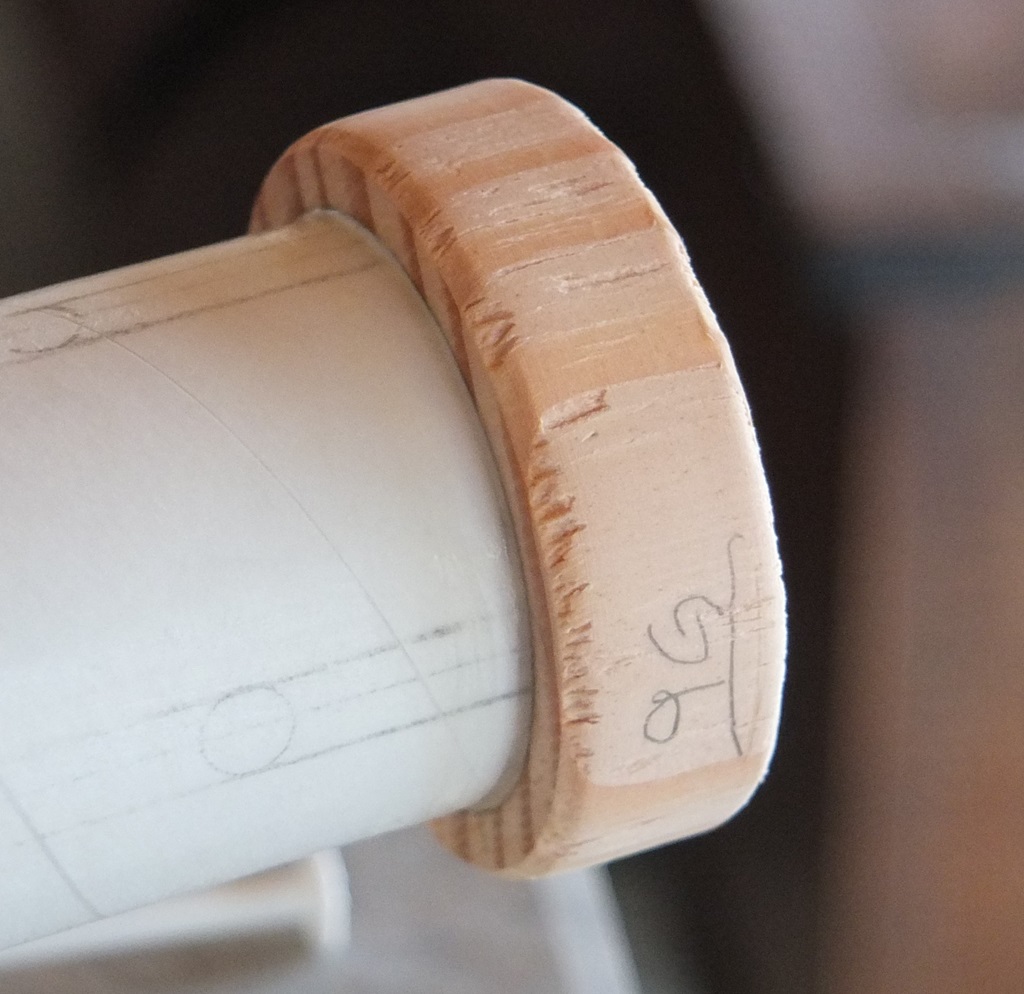
So I cut off an 8 inch long piece ($2.40) chucked it in the Jet wood lathe and made the Nose Cone and the Ring at the base of the Nose Cone.


2024-09-20  Fins and Tubes

Cut the fin templates from paper, transferred it to cardboard, then to some 1/4" plywood which was cut using a scroll saw and then sanded to shape.​
I also prepped the tubes for the fins. The Lower Fins will glue to the internal C-60, the Upper Fins and Launch Lug Mount to the surface of the BT-60.​
Using the OpenRocket fin guide the Body was layed out for the fins. Using a circle template, 5/16" dia. circle were drawn on each of the Lower Fin locations, and a 1/4" dia. circle for the Upper Fins. Lines were then drawn for the fins from the outer extremities of the circles. It's just an easy way to lay out the tube.​
I used my 3/4" aluminum angle as a straight edge and then cut the slots into the tube.​
Elmer's School glue was used to attach the inner C-60 to the Outer BT-60.​


Fin Attachment Using Fixture

This is the 1st rocket where I am using my fin attachment fixture to locate and attach the fins.​
One thing is that while it does a great job of aligning the fin perpendicular to the rockets vertical centerline, it does nothing to orient each fin to each other.​
But...​
  • On a (4) fin rocket, if the spreader fixture is used in conjunction with the alignment fixture, those two fins would indeed be 180 degrees apart.
  • And if another fixture that I can use that spaces the fin 90 degrees from each other, that should also work.


All that being said, the fixture is pretty great. I installed all the fins in about a 3 hour time frame. 


2024-09-20 Nose Cone Ballast and Recovery Dowel

Ballast:​
A 4" long piece of 1" steel bar stock was placed in the chuck of the wood lathe, then an angle grinder with a 1/16" thick cut off wheel was used to slice off a 1-1/2" long piece. A groove was cut in the o.d., also with the angle grinder.​
Final weight is 156 grams​
Recovery Dowel:​
This was cut via a hack saw from a piece of 3/8" steel bar, it's about 1-1/2" long also.​
Final weight is 18 grams​
Gorilla Wood Glue was placed into the Ballast o.d. groove and it was then slid down into the counter bore of the Nose Cone. Then a fillet of wood glue was placed around the o.d. with a syringe.​
The Recovery Dowel is a tight press fit into the 3/8" cross bored hole in the Nose Cone Hub.​


Gluing the Nose Cone and Upper Fins

The Upper Ring was Gorilla Wood Glued to the Body Tube o.d..​
A piece of 300# Kevlar Shock Chord was attached to the Recovery Dowel.​
Two holes were punch through the Body Tube just below the upper ring.​
Wood Glue was applied to the face of the Upper Ring and the Nose Cone was set into place and allowed to dry for 1/2 hour.​
Wood Glue was injected into the two punched holes until the glue started to build up on the face of the Nose Cone Hub inside the rocket.​
The rocket was held upside down and spun for 45 minutes at 45 degree angle.​
The O.D. of the Upper Ring was wood glued to the Nose Cone.​
The Upper Fins and Launch Lug Support were glued to the Body Tube and to the Nose Cone.​


 2024-09-22 Glue Fillets


 2024-10-06 Spool Build, Day 01

Cut some Centering Rings and Body Tubes for the Spool.​
I had planned to use some BT-20 for the Ejector Tube... but I dug through my body tubes and none was on hand. So I used some Starbucks Tubes I had saved. Kind of a tube-in-a-tube set-up. The blue and pink striped tubes are 0.51 o.d., and the white tubes are 0.41 i.d.. I used wood glue to glue them together, and used a wood glue wash to fire-proof the inside of the tube sub-assy.​
The motor tube is BT52H and is foil lined. The foil was sanded off the area where the ejector tube glues into the tube.​
I glued one of the large Centering Rings to the BT52H, and let it dry a few hours, and then took it out and turned the Centering Ring for a slip fit into the rockets C-60 Inner Tube.​
The two smaller Centering Rings were glued to the 0.51 o.d. tube and this sub-assy will glue into the BT52H.​
Clear as mud? The assembled spool model is shown below the photos...​
Note:
The rubber ejection plug that is supplied in the composite motor needs to be removed prior to flight. If it isn't removed... the plug has a high likelihood of getting stuck in the spools ejector tube... and an "anomaly" would occur :oops:​😟


2024-10-07 Swing Test
Swing tested the Atomic Cap Rocket today. :headspinning::headspinning::headspinning:

It passed with flying colors. I'm thinking it's over stable.. I moved the string back away from the nose to really test this one... and it still flew stable.


2024-10-11 Primer and Paint
Primer: Rustoleum Rusty Brown (Red Oxide), 
Paint: Rustoleum Metallic Silver