Tuesday, May 23, 2023

(BAR-16) The Estes Logo Rocket

2023-05-23 The Estes Logo Rocket

You know... the Estes logo. It's "That" Rocket.


2024-05-31 Flight Report, Photos and Video

Launch Report: Estes Logo Model Rocket

Date: 2024-05-30​
​
Background​
​
This is the maiden launch of this scratch build / design model rocket​
​
On Site Preparations​
​
I did not use any wadding for this rear eject spool design. There’s simply no room.​
​
For a parachute I used a 18” Nylon chute.​
​
This launch will use a E20-4W Composite motor. This is Aerotech’s “White Lightning” propellant which.​
​
The supplied Aerotech igniter was used.​
​
The rocket was slid onto the 5/16" launch rod and the controller wires were attached to the igniter leads.​
​
Launch​
​
Wind was out of the East and was about 4 mph at the most.​
​
John stated the sky was clear - launch site was clear and did the countdown: 5-4-3-2-1. Teresa pushed the button on the launch controller.​
​
The motor ignited and the rocket leaped off the pad. It flew stable upward but then went unstable heading toward the South where it ground hit, 128 feet South of the launch horse. The delay was still burning, and the rocket ejected its chute.​
​
Condition of rocket after the flight​
​
The rocket was uninjured and flight ready. "Hell-For-Stout" construction paid it forward.​
​
Conclusions​
​
This rocket has a calculated stability of 0.059 calibers. With the base drag hack it has a calculated stability of 1.16.​
​
A string swing test was performed and the rocket passed that test.​
​
What I learned​
​
There must be some other phenomenon affecting the flight of this rocket?​


Launch Report: Estes Logo Rocket –With Spin Tabs

Date: 2025-05-08

Background

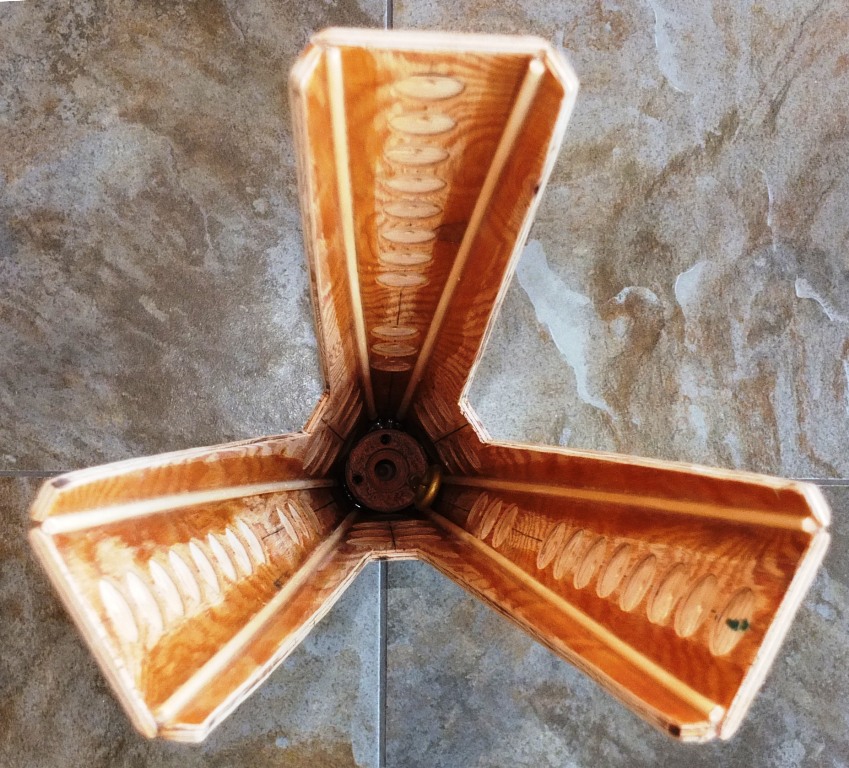
This is a single stage scratch design / built rocket.  It is a model of the rocket depicted on the Estes Industries logo. 

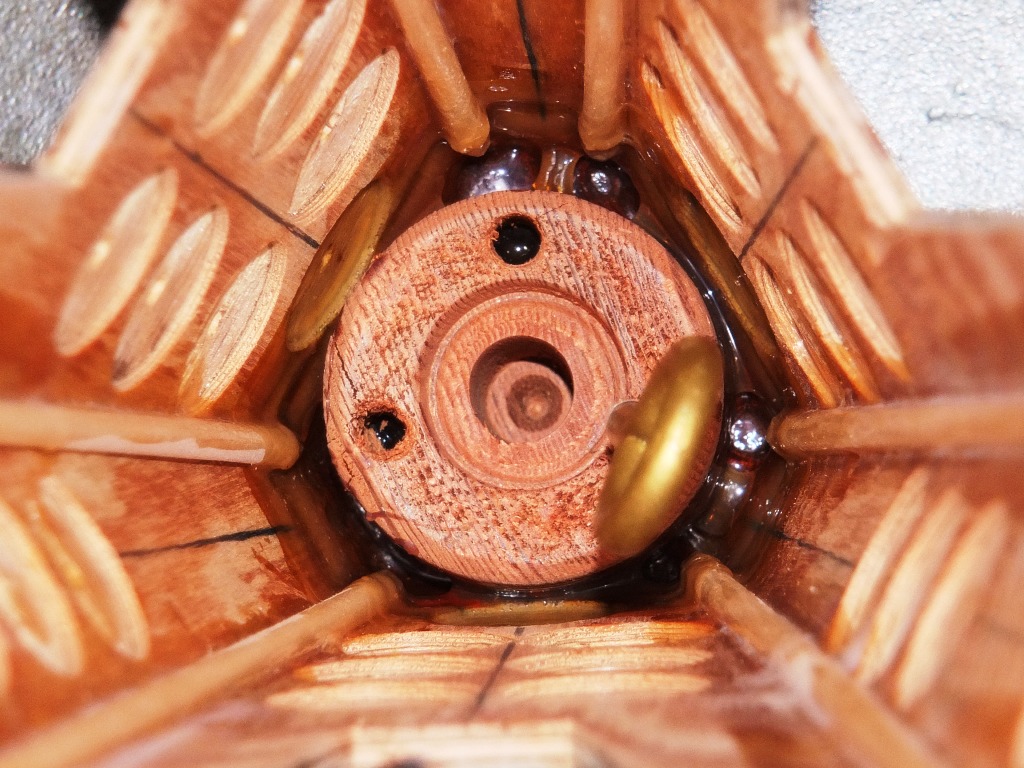
The rocket is of a conical shape and was made from a solid piece of redwood.

This is a rear eject rocket.

This is the 2nd launch of this rocket.   The 1st launch was stable under thrust, but tumbled during coast.

This version has “Spin Tabs” located on the trailing edge of the 3 fins, to induce spin.   

On Site Preparations

For a parachute I used a 18” Nylon chute.

An igniter was installed in the motor and secured via a rubber band.

The rocket was slid onto the 5/16" launch rod and the controller wires were attached to the igniter leads.

The site was clear and no outside observers were present.

Launch

Wind was out of the West / Southwest and was about 4 mph.

The Aerotech E30-4 motor ignited and the rocket leaped off the pad. 

It flew stable off the rod, 35 mph estimated, through both Thrust and Coast phases, to about 350 feet.

At ejection the chute deployed and the chute blossomed.

The rocket landed 274 feet from the launch pad, to the North-Northwest. 

Condition of rocket after the flight

The rocket was recovered undamaged.

Conclusions

The rocket was stable. The spin tabs worked.

What I learned

This was a spectacular flight. 

Due to the odd shape of the body this rocket needed to spin to maintain stability.

The photos and launch video reflected this flight accurately.


Saturday, April 29, 2023

(BAR-15) The Razorback

Launch Report: The Razorback

Date: 2025-05-12

Background

This is a single stage scratch design / built rocket.  It is similar in shape to The Razorback from the TV Series The Expanse. 

The rocket has an Altimeter Storage Bay.

This flight included an Altimeter Two.

This is a rear eject rocket that utilizes a spool.

On Site Preparations

For a parachute I used a 24” Nylon chute.

An igniter was installed in the motor and secured via a rubber band.

The rocket was slid onto the 5/16" launch rod and the controller wires were attached to the igniter leads.

The site was clear and no outside observers were present.

Launch

Wind was out of the Southwest and was about 4 mph.

The Aerotech G74-4 motor ignited and the rocket leaped off the pad. 

It flew stable upward to apogee (387 ft), the parachute deployed and the rocket slowly came back to Earth.  

During the coast phase the rocket was very quiet, no sound at all.

The rocket landed 227 feet from the launch pad, to the South-East.

Altimeter Data

Altitude: 387 Feet           Top Speed: 144 mph      Thrust Time: 1.4 Sec.     

Peak Accel: 7.3 G’s        Average Accel: 6.30 Sec.   

Coast to Apogee: 0.2 Sec.                Apogee to Ejection: 0 Sec.

Ejection Altitude: 387 Feet              Decent Rate: 13 mph

Flight Duration: 20.5 Sec.

Flight Profile

The flight under thrust and coast were both straight, very little spin was observed.

Condition of rocket after the flight

No damage.

Conclusions

The rocket was stable. 

The delay was spot on.

What I learned

This was a spectacular flight. 

The photos and launch video reflected this flight accurately.

The view of the rocket from the ground was amazing.  The tri-lobed sides, with the light shining through the cut-outs was awesome.  And the rocket “under chute” with the rear eject was quite spectacular.

Flight Video: The Razorback


Nobody Beats "The Razorback", from the TV Series The Expanse, 29mm Power, Rear Eject, Unique Nose Cone and Fuselage

First Launch: Pending


Thursday, March 30, 2023

Test Mule: Neato! Train Whistle Rocket


2026-03-30  Bought this toy train whistle at Tractor Supply, three years ago to this day. 
Weird right? Lets see if we can make this one whistle!
 
Took the Whistle out to the shop and drilled a 1" dia. hole x 1-3/4" deep Counter Bore in the end. That's where one of the (4) whistle bores stopped. (There's 4 holes at different lengths... that gives it a "Train Whistle" sound, a "Chord" if you will.)

Then started gluing a 3" long piece of BT-52HMF to the bored end.

Ran a couple of quick Open Rocket sims to get a feel for how big the fins need to be. I know, I know... it won't simulate correctly without a pointed nose cone. Well, this has a flow through nose on it.

It's a Test Mule, we'll swing test it and go from there.​
Plan is to glue the fins on and then swing test it. If it doesn't make noise I'll glue some shrouds where the noise exits and see how that works, assuming it's stable.​

3 years ago I tried blowing some shop air through a regular whistle, the one with a ball in it, and it didn't work unless I put my finger in front of the little slot where the noise comes out. I speculate this will have the same result.


2026-03-31 Pieces Parts

I sanded the Whistle for the Dowels, then cut the C-55 and the Dowels.


Glued the C-55 over the BT-52HMF.​

Glued the Dowels, 1st with Gorilla Wood Glue, then with Titebond Quick and Thick.​


​
Updated the Open Rocket Simulation to include some 1/4" thick fins that I had in stock, unused from my Gus Grissom's Ride​​


2026-04-03 The saga continues...

Glued the fins on and swing tested the rocket... unstable.​


​
So I decided to install a 4" nom. dia. Ring Fin and swing tested the rocket... flies consistently backwards.​

​


Then I chucked the rocket in the wood lathe and gave the nose a rounded profile... swing tested the rocket... flies consistently backwards.​


​
Glued on the launch lug...​


​

Revised Open Rocket Simulations


This rocket is square... well at least the front 2/3 of it is. This is uncharted territory for me. Open Rocket doesn't have "square" body tubes. I added up it's perimeter and divided by pi to come up with a diameter to plug into the simulation.​
​
It passed the swing test, both forward and backwards. Although forward the rocket flew much straighter.​
 
Ran some quick numbers by reviewing the video and it looks like my spin test was at about 26 mph.

Open Rocket calculates the off the rod speed to be 76 mph on a G74.

That's 3 times the speed... is that enough to make the whistle blow? I'll get back to ya.
 
2026-07-25 Made the recovery spool. It's the little Disc With Dowel. 


2026-07-26 Recovery Dowel

Drilled through the Rocket and installed a Recovery Dowel. Kevlar attaches to the Dowel, the Parachute, the Recovery Spool and to the Motor.​
​
This rocket uses the "Pop and Pull" recovery method of rear eject. It utilizes a Metal Foil Lined Motor Tube. What remains to be determined is if the "gunk" of the ejection blast will fowl the Recovery Spool such that it cannot slide out of the Motor Tube.​
​
This rocket will be the test mule for this ejection style.​